Inheritance
HERDspotting between the generations

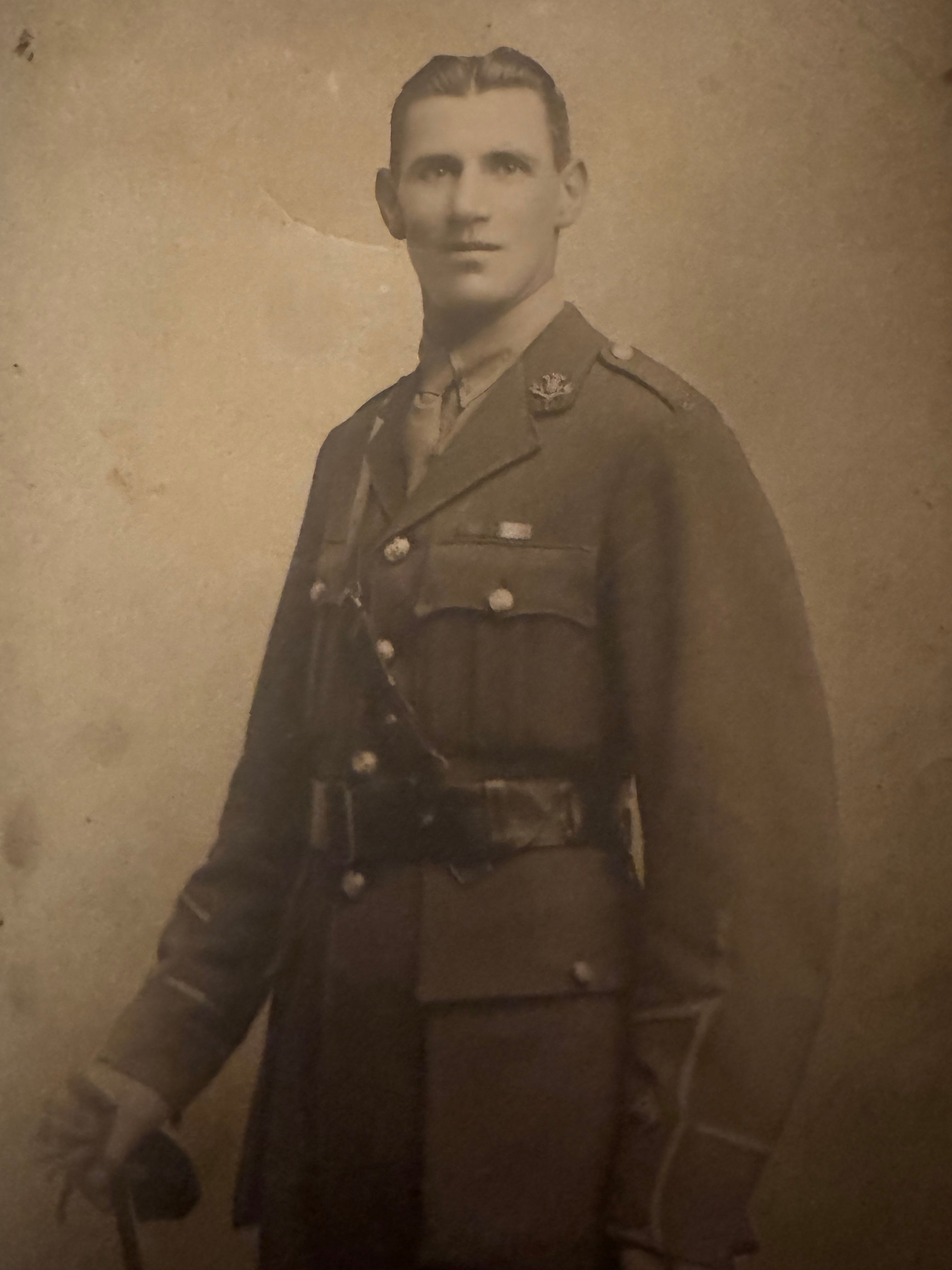
My grandfather was, by any normal standards, a very brave man: mentioned in despatches, a man who risked his life to save his friends and invalided out of the Somme. A steelworker out of place.
His name was Michael — Mike sometimes, Mick on other occasions, depending on the situation and who was speaking.
I met him a number of times as a child. My parents made sure we got to know our grandparents properly, not as distant figures but as people who had shaped the family long before we arrived. My grandparents were late Victorian; my parents, mid-century.
To be honest, we were a little scared of Poppa. He was austere. Distant. Upright. A man of steel who refused to bend. Proud and strong.. A man who knew how to use his fists and those powerful shoulders. Hands like shovels, eyes somehow empty. He carried himself as if there were rules still being enforced — discipline and standards to be defended — even though no one else could see them. The last man standing.
The thing I do remember is that he woke screaming. Not occasionally. Not metaphorically. Night after night, decades on, he woke shouting his horror: the men he had lost in the mud and the shit of the trenches. The viscera. The body parts left behind. The wasted lives. The hollowness of the survivor.
And yet my grandfather was a respected figure in the community. A pious Catholic, a pillar of the British Legion Club, and even a prize fighter in the depths of the Depression. He was called on to present the remnants of the regiment to the King when he visited his small seaside town. A man to look up to. A fine figure. A hero, even.
But in the family, the first war wasn’t a story in our family so much as a background condition. Poppa carried a piece of German shrapnel in his body for the rest of his life. But that was a merely physical marker. And not the whole truth.
“Shell shock,” people said.
“Those men had it hard.”
And even, “That’s just how he was.”
But “just how he was” doesn’t really cut, does it?
Because whatever happened to him didn’t stop with him. It never just was: it still is.
Looking back now, it’s clear there was something fundamentally broken inside him — not morally, not emotionally in the way we now talk about trauma, but structurally. As if a load-bearing wall had cracked and the whole building learned, silently, to compensate. He survived. He returned to his beloved wife and his hometown. He had children, six of whom survived the poverty he was born into and whose lives were significantly better than his. Many, like my father, chose to leave. Life went on and changed and moved — but there remained the void that no one quite named.
That void shaped my father and, I suspect, his siblings, too
The inheritance
My father grew up with a man who was physically present and emotionally absent: disciplined, correct, restrained, and unreachable. Affection as we would recognise ti now was sparse. Violence and physicality in the air, always a possibility. Disapproval ready. Praise rarer still.
That, in turn, shaped me.
Not in any neat, causal way. My father was not a physical man like his father; he escaped the steelworks for the grammar school. He lived for poetry, music, art and feeling; a dreamer who wandered far and wide. Not for him the world of the council estate perched above the old port town. The Legion club or the parade ground. Nor the heat of the blast furnace.
But what gets passed down isn’t the things or the actual experience. More like the emotional plumbing: pressure rerouted, joints reinforced, leaks appearing elsewhere. The system holds still, but only by redistributing strain. The plumbing is what we are heirs to.
What was passed down to me wasn’t the memory of the Somme. I have no authentic images of the battlefield in my head. No flashbacks. No nightmares of mud and wire — at least, only very occasionally and third hand, informed by the comic books and the stories told by others. What I inherited was a way of being in the world, shaped by something unspeakable that had happened to someone else, and by the silence that followed it. By the way it shaped my father’s life: the thing he spent his whole life navigating around.
Shared history means shared memory. But shared memory means shared emotional plumbing.
Lest we forget
Every November we say “lest we forget”, at the Remembrance services we attend and in pinning the poppies we wear to our coats. In the minutes silence at the eleventh hour of the eleventh day. By forgetting we usually mean forgetting facts: dates, battles, individual sacrifice, names carved into stone. Or the order of events. Not the pain and the voids handed down across generations.
Forgetting doesn’t begin with amnesia. A blow to the head. Or hypnosis. Or a malevolent virus. It begins when we treat memory as something informational that sits neatly inside individual heads, rather than something foundational that lives between people, across generations, embedded in habits, absences, and patterns of feeling.
My grandfather’s war ended in 1918.
Its consequences did not. They haunted him.
Let me be clear. This is not about blame. It’s about acknowledgement of what each generation inherits from those that precede it. What lives in the bones. What lives on.
Because once you see memory this way — not as recall, but as inheritance — a lot of the world starts to make more sense. It’s true for families and at a larger scale, too. Multi generational trauma affects us all. Nations, like families, carry unresolved pasts: long-ignored voids. So do institutions. So do organisations that insist they are “moving on” while quietly rebuilding the same structures again and again.
History does not sit behind us.
It runs through us.
And unless we learn to embrace the history that lives with us, we will keep mistaking inherited damage for personal failure, and calling deeply social phenomena — the cognitive plumbing we share — “just how people are.”
“Lest we forget.” Really?
Spotting tips
Look for inherited absences as much as inherited stories. Pay attention to what is not recalled because “we don’t think about that” — the blank spaces, the voids, the silences that are never named.
Notice what never gets talked about in families, teams, or institutions — and what behaviours seem to organise themselves around that silence. The compensatory moves, the over-control, the emotional narrowing, the reactions that once made survival possible but now play out in very different contexts.
Ask not just “what do I remember?” but “what shaped the people who shaped me?”
And then ask the harder question: what shaped them — and what were they adapting to?
References & further reading
On Collective Memory
Halbwachs, Maurice (1950; English translation 1992). On Collective Memory. University of Chicago Press.
A foundational account of memory as something produced and sustained socially, rather than stored privately in individual minds.Trauma and Recovery
Herman, Judith Lewis (1992). Trauma and Recovery: The Aftermath of Violence — From Domestic Abuse to Political Terror. Basic Books.
Links individual suffering to family, social, and political contexts, and shows how trauma reorganises relationships as much as minds.Cultural Memory and Early Civilization
Assmann, Jan (2011). Cultural Memory and Early Civilization: Writing, Remembrance, and Political Imagination. Cambridge University Press.
Explores how societies stabilise memory across generations through ritual, narrative, and institutional forms.The Body Keeps the Score
van der Kolk, Bessel (2014). The Body Keeps the Score: Brain, Mind, and Body in the Healing of Trauma. Viking / Penguin.
Shows how unresolved experience persists as patterned bodily and emotional response — memory expressed through regulation and repetition rather than conscious recall.
Thought provoking and moving, as always. Thank you Mark for your invitations to look and see what’s in front of us differently, and to see it socially.
Your Spotting tips are the essence of anthropological method. Always be observant of what is not seen and heard! Thanks for a great post!